


Work Accomplished
This page showcases just a few examples of the work we’ve done eradicating invasive plants at over 100 sites. It also shows the surprising extent of ivy infestations, a common aspect of these being prolific berry production.
Cooper Gulch Park, Eureka
Under construction, but take a gander at what we have up.


Before and After daylighting and removing many fruiting holly trees from a section of the park


Before, the vegetation (mostly holly and cotoneaster) was very thick and came right up to the edge of the walking paths. Walking these paths felt a little claustrophobic and slightly unsafe.
After opening up this area to the right, we were delighted to find well established oregon grape plants and twinberry bushes, giving the native plants a headstart to restoring this habitat.
Although not all invasive plants that we cut down were removed from the park, we have filled up dumpsters with 47,080 pounds of green waste material as of October 9, 2026.
We had to haul green waste out of the park to dumpsters in either the main parking lot or on the West side of the park on 11th street. The parking lot was between 900 and 1,050 feet from where we brought most of the green waste from, about one-sixth of a mile, one-way. The 11th street location was used for areas further west, and was a shorter distance than the above (about 225 feet), but uphill. A typical green waste day involved 15 trips or more, in-other-words, five miles of pushing the cart.
All this chopping generates a lot of greenwaste

Holly is nefarious and will joyously sucker and resprout if only cut to the ground. Our volunteers and the CCC's along with park staff have been digging out holly stumps to finish the job.
We constructed two carts for green waste removal, as wheelbarrows are not well suited for this task. The cart we settled on was eight-feet long and therefore could accommodate long branches, saving us time processing green waste.
We learned how to more effectively unload the cart into the dumpster by using tarps to create layers of green waste that could be removed, which we called the “lasagna method.” The eight-foot cart also had a removable wall, making unloading quicker.

On seven occasions, the city used a forklift to move green waste from where we piled it to the dumpster. This saved us a lot of time, as we wouldn’t have to move the green waste as far. Because the forklift can push down the green waste in the dumpster, we wouldn’t have to break down the green waste as much, saving us even more time.
Over the river and through the woods, this holly has got to go!

Incidentally, this picture of us removing greenwaste from Cooper Gulch park won the photo contest for the 2026 Cal-IPC Symposium. Thank you, Ron Taylor, for capturing our work so majestically.
We've Been Busy
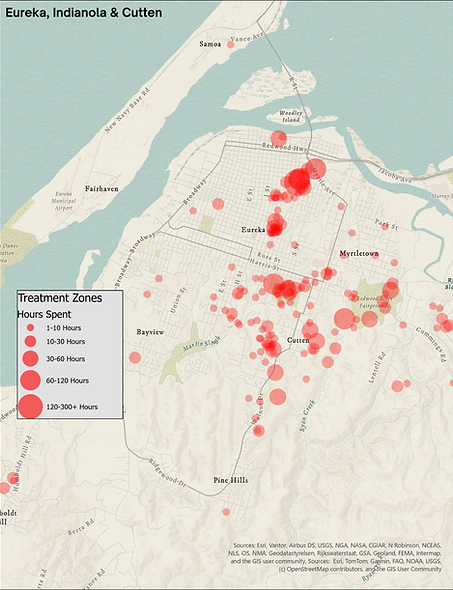
Hours of Work by Site Jan 1, 2023 to Feb 10, 2026
Thanks to Fae Touchstone for creating these maps!



Berries
Fruiting Ivy on 3 Trees
at Eureka High
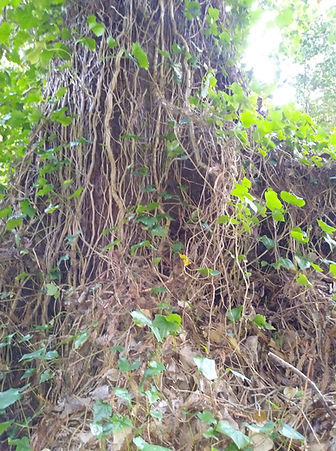
On March 14, 2024 these massive infestations of ivy on three trees were girdled and many roots were removed. This only took three hours and six minutes of work. If roots were ignored, this could be done much faster. If we assume at least one thousand pounds of ivy in each tree, that means a minimum of 3,000 pounds of ivy was killed.

Lots of Berries
Tree#1 Before
& After
Angle 1
Angle 2
Angle 3
Angle 4
Angle 5
Angle 6




Tree#2 Before
& After
Angle 1

Angle 2
Angle 3
Angle 4


Angle 5


Tree#3 Before
& After
Angle 1

Angle 2
Angle 3


Fruiting Ivy on Fence
at Eureka High

Zoom in,
if you dare
The fence inundated with berries was 200 feet long, with another 50 feet of fence running down the hill with many fewer berries on it. With two feet of ivy bushing out at the top, the fence was 10.33 feet tall, and the depth of the ivy was approximately three feet on average. This comes to a total volume of 6,200 cubic feet. Given that we estimated there were 6,593.4 berries in a 250 cubic foot space, we estimate there were 163,516 berries on the fence.
This fence is about to be removed because of the planned remodeling of the EHS athletic area. However, we prevented an entire year of berries from being dispersed.
Last Year's Berries
Not a single berry escaped the rath of RIPE
A Better Look at Those Berries
Ivy Lianas Can Become Ivy Trees
Before & After


The After After Video

Across the Creek
(Don't worry, we got it too)
Fruiting Ivy on Deadfall
on Ryan Creek

Moderately Sized Tree Being Engulfed

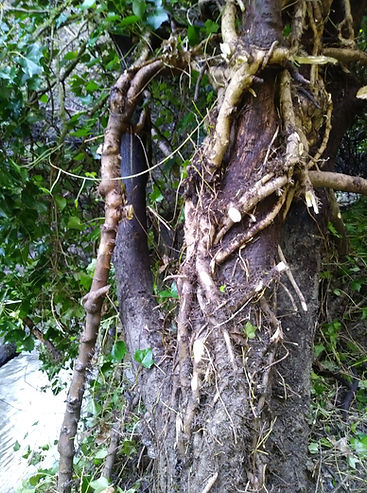
Midway in the process: the leaves have been stripped and you can see the structure of the lianas
Sad Wilting Ivy
Fruiting Ivy on Bleachers
at Eureka High


Before
After
This ivy has been separated from it's roots and will die. We left it on the wall because it was french-braided with rebar.
All of the ivy we pulled down would have died anyway, but we were concerned that our efforts wouldn’t be appreciated if we left ugly dried out ivy in plain view of the track and bleachers.
We sawed
We snipped until we could snip no more
Then, we yanked

Fruiting Ivy on Deadfall
along Walnut St. in Cutten

One day, on our way home, we were shocked to find a wall of fruiting ivy right in our very neighborhood. Once we got a better look at what was going on, we were appalled and darkly fascinated by the latticing structure of the main ivy lianas. These appeared to have been a series of deadfalls; the trees died, but the ivy continued to thrive. For some, the tree is completely rotted away, leaving only a tube shape in the ivy lattice where it used to be.
